FAQs
FAQ
Who is leading the Westmoreland Broadband Program?
Westmoreland County Commissioners and Westmoreland County Planning & Development are leading the program with guidance from a taskforce of core community leaders, who provided the foundation for the Data Collection & Feasibility Study.
What type of funding will Westmoreland County receive?
The County anticipates using funding from its existing American Rescue Plan Act (ARPA) budget, potential grant awards and expects that it will partially be supplemented by ISP partners who will also invest their own funds into projects through the competitive proposal process.
When will home or business get better internet access?
Residents and businesses within the county will have the opportunity to connect to newly deployed infrastructure at different times. Factors that affect when new services might be available in a certain area include the geographic location of the area in question, as well as the awarded ISP’s internal process for deployment. The County recognizes that bringing broadband to unserved areas will be an incremental process and that ISPs will be working area by area. Updates on deployment plans and construction progress will be made available at westmorelandbroadband.org.
What is the timeline for this project?
The project is currently ongoing, with initial planning and data collection completed in 2022. Since then, efforts have focused on refining priority areas, securing funding, and advancing partnerships with service providers.
What is the difference between unserved and underserved?
The Federal Communications Commission (FCC) recently updated its definition of high-speed internet to reflect modern needs. As of March 2024, high-speed broadband is now defined as service offering at least 100 megabits per second (Mbps) download and 20 Mbps upload. This new standard recognizes that older thresholds—such as 25 Mbps download and 3 Mbps upload—are no longer adequate for activities like teleworking, remote learning, and maintaining social connections. For the purposes of this program, underserved and unserved are defined as follows:
- Unserved – Locations with no access to wired internet service at speeds that meet the FCC threshold of 25 Mbps download and 3 Mbps upload, meaning the Internet connection is slow and unreliable or nonexistent.
- Underserved – Locations where Internet service is at or above the FCC threshold but with no access to wired broadband service at speeds of 100 Mbps download and 20 Mbps upload, leading to slow or unreliable service.
How were Westmoreland County’s Early Action Projects selected?
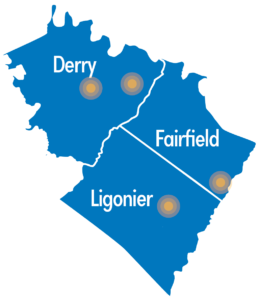
Early Action Areas were selected by first identifying unserved and underserved locations, then evaluating those areas based on need, number of locations served, cost efficiency, and feasibility for quick deployment. The goal was to prioritize areas with the greatest need that could also be implemented quickly, resulting in four projects in Derry, Fairfield, and Ligonier Townships.
How much does this program cost?
The study recommends a budget of at least $43M for total project costs to deploy fiber infrastructure to the unserved locations identified, of which up to 50% of the total project cost may be supported by Internet Service Providers (ISPs).
What are Connectivity Opportunity Areas?
Connectivity Opportunity Areas represent areas that are top priorities for access to new service due to little or no access to mobile or fixed broadband. This data, when cross-referenced with sociodemographic factors and planned expansion projects, will allow Westmoreland County to direct targeted investment.
What is an Early Action Project?
Early Action projects are unserved locations that were prioritized for quick implementation based on a detailed evaluation of fieldwork and survey responses determining a high need for service in those areas. Verizon has installed broadband infrastructure for all of the Early Action Projects in Fairfield, Derry, and Ligonier Townships. The 2023 Westmoreland Broadband Feasibility Study identified these townships as prioritized areas with the greatest need for internet access.
Is there a way to lower my monthly internet bill?
You may be able to lower your monthly internet bill through the federal Lifeline program. Lifeline offers a monthly discount on broadband or phone service for qualifying low-income households. To check your eligibility and apply, visit the Lifeline website www.lifelinesupport.org, call 800–234-9472, or contact your internet service provider for more information.
What is the latest project update?
Westmoreland County’s Broadband program continues to make progress, with ongoing deployment of fiber infrastructure and prioritization of unserved areas for early action projects. The county is actively collaborating with Internet Service Providers to maximize investment and ensure expanded access for residents.
What is the Broadband Ready Communities Program (BBRC)?
The Broadband Ready Communities Program (BBRC) is an initiative that encourages local governments to adopt policies and procedures that reduce barriers to broadband infrastructure investment. Communities that participate gain recognition for being proactive in supporting broadband expansion and may be better positioned for state and federal funding opportunities.
What happened to the Affordable Connectivity Program?
The Affordable Connectivity Program (ACP) was a federal benefit that helped qualifying households pay for internet service. However, due to the exhaustion of federal funding, the ACP stopped accepting new applications and enrollments as of February 7, 2024. The final ACP benefit was applied to eligible participants’ bills in April 2024, after which the program officially ended. For the latest information, households are encouraged to contact their internet service provider or visit the official ACP website.
Join the Mailing List
Want to get project updates directly to your mailbox? Join our mailing list.
We’ll update you on project status, website updates and when we have big things to announce!